

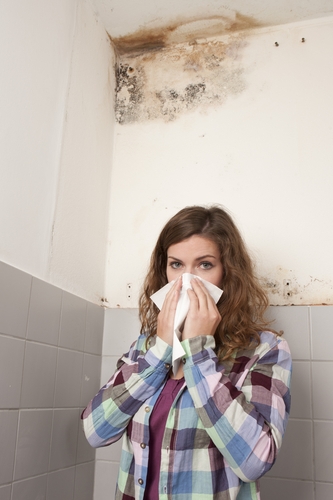
Could a home mold problem be contributing to health issues in your household? Mold exists everywhere in nature, playing an important and usually harmless role. However, mold growth confined within the enclosed environment of a house subjects occupants to daily doses of airborne mold spores in concentrations not encountered outdoors. Reproductive spores released by active growing mold can accumulate to toxic levels inside today's tightly-sealed, energy-efficient homes.
Signs of Mold Issues
Physical symptoms of mold exposure appear in susceptible individuals, while others may be unaffected. Common effects include respiratory problems like asthma, frequent sneezing, coughs and sneezes. More comprehensive symptoms like fatigue, headaches and even depression are also reported.
How Does Mold Grow?
Dormant mold spores that circulate in household air require only two elements to become actively growing mold: moisture and food. Any wetness inside a home, ranging from chronic high indoor humidity to water damage from a flood or plumbing rupture, inevitably triggers mold grow, and often in unseen, inaccessible areas where water seeps. Mold food is abundant inside most homes, usually in the form of microscopic organic material that's continuously settling on surfaces and infiltrating cracks and crevices.
What Can I Do?
An established home mold problem usually requires professional remediation. Once mold has a foothold, it's rarely limited to the area where it's initially found. Simple removal isn't sufficient. Affected surfaces and building materials must also be decontaminated with approved substances. I
n addition to professional treatment, homeowners can prevent recurrence by eliminating sources of moisture and adequately ventilating mold-prone areas like the crawl space, basement and attic.
For professional evaluation and treatment of a home mold problem, contact Rytech, Inc.
Image via Shutterstock.com


